You're Benchmarking the Wrong Layer
Everyone's arguing about which AI model is smarter, the way we once bought cameras by megapixels. What actually decides whether AI can do real work in your business is a different layer most people aren't even looking at.
Let me start with something that has nothing to do with AI. Fifteen years ago, everyone shopped for cameras by megapixels. Ten million, twenty million, a bigger number meant a higher price, and that was the whole conversation at the counter. Then what happened? Phone cameras caught up to and passed the standalone cameras of that era, yet what actually decides whether a photo looks good is the lens, the software behind it, and whether the person shooting knows how to work the light. Megapixels, the one number everyone compared, quietly turned into the least worth comparing.
I work with AI every day, and lately this keeps coming back to me, because the AI world is running the same story again.
There's a question people have been arguing in circles lately: can a free AI running on your own computer take over from the paid, top-tier one for real work? One camp says local is cheaper, private, and runs offline. The other says it still falls short, and you crawl back to the expensive one when it counts. Hundreds of comments, plenty of heat. But almost nobody stops to ask whether the question itself rests on a false premise.
That premise is that what decides the swap is how smart the AI itself is, as if the day the free one's "IQ" catches up, the deal is sealed. My read runs the opposite way, and it holds for anyone trying to put AI to work in a business: most people are watching the wrong layer.
Getting an AI to carry a whole job for you, the kind of messy, multi-step work a real task is made of, comes down to whether it can stay coherent across dozens of steps. A real task is dozens to hundreds of rounds: read the material, act, check, catch the error, fix it, run it again. The "brain" is just one part being called over and over inside that process. How smart it is on any single call matters far less than how steady the whole process stays.
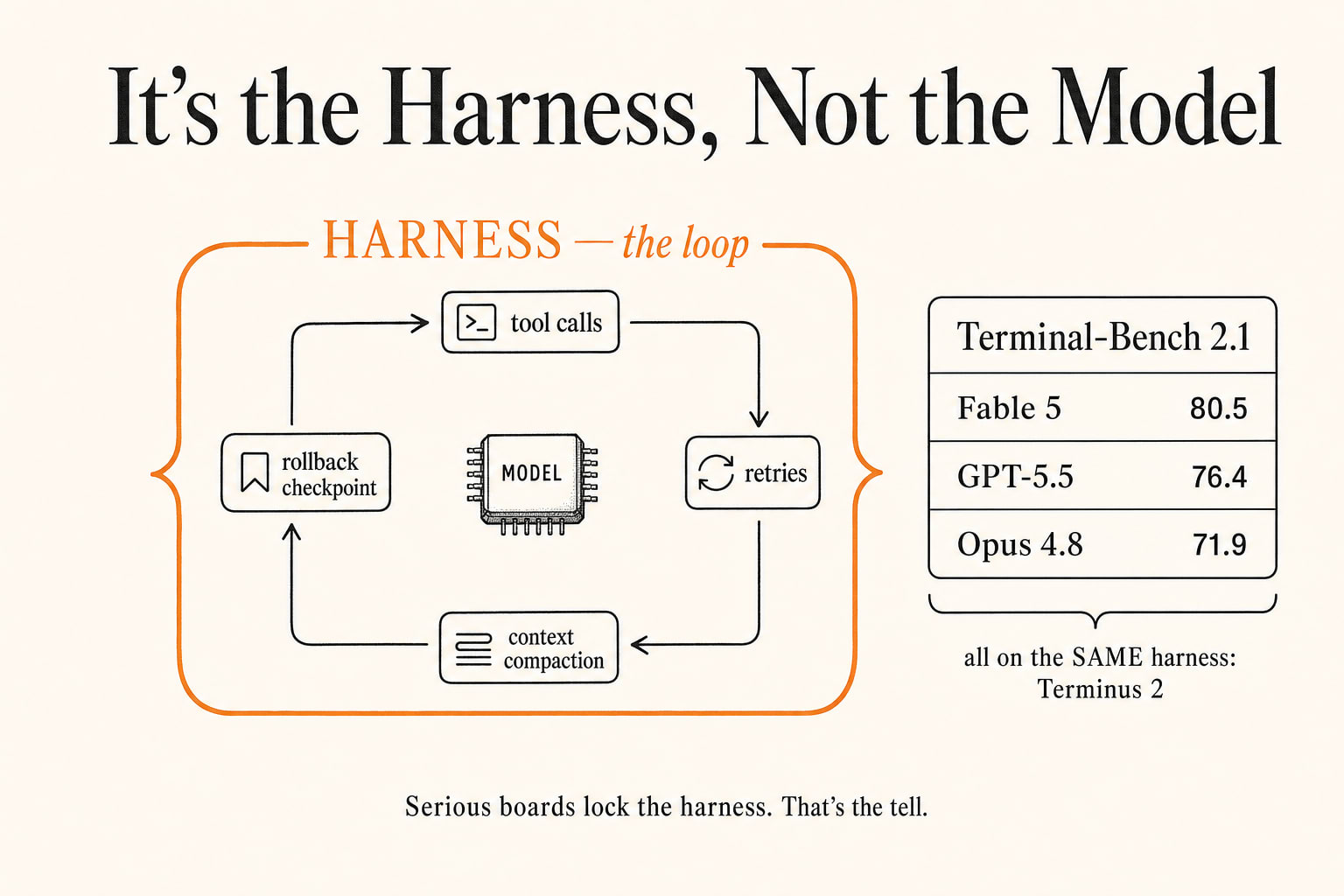
What actually decides whether that long chain holds together, or ties itself into a dead end halfway through, is the process wrapped around the brain. The field has a word for this layer, the harness, as in scaffolding: how it plugs into the tools you already use, who catches it when it slips, how it gets pulled back when it starts to drift, whether every step leaves a checkpoint you can roll back to.
This layer isn't glamorous, and nobody brags about it on a launch stage. But it happens to be the layer you can reach in and change. The brain belongs to someone else and you can't touch it, and every vendor's version is converging and getting cheaper, turning into something like tap water and power from the wall. The process around it is your own craft, the place where you actually pull ahead.
I've felt this firsthand. In the AI setup I run every day, swapping the brain in the middle for a pricier, stronger one often changes almost nothing. The one time I reworked a single unglamorous step, making it verify its own work after every move and roll back when it failed, the whole thing got visibly more usable. The real leverage was never sitting where everyone is busy comparing.
Put it in one line for a decision-maker. When someone talks AI with you, the topic is almost always "which model is strongest, who just overtook whom." That's the camera counter all over again. The question you should actually ask sits one layer down: can it plug steadily into the work I already do and run dozens of steps without losing the thread? Is there a backstop when it slips? Is this process something I control and can keep refining, or is it bolted to a single vendor?
Back to that "can a free AI replace the paid one" question, my answer is to ask it differently: don't ask whether the free brain is good enough, ask whether your process is steady enough to keep running no matter which brain you drop into it. With a crude process, even the strongest, priciest brain just pushes the crash a few steps further out. With a steady process, the day a free brain can take over arrives sooner than anyone expects.
The brain will stop setting anyone apart soon, since every vendor's is converging on the same thing. What's worth your effort is everything you build around it, the part nobody else can take from you.